Hekate and Liminal Times: Thresholds, Seasons, and Sacred In Between Spaces

Hekate has always been a goddess of the in between. She is present at the edges, the crossroads, the thresholds where one thing becomes another. Most people know her as a Goddess of Liminal Spaces, but she is also a Goddess of Liminal Times. These are the moments when a cycle ends and another begins, when the air feels different, charged, and open. These are the spaces where the world shifts, where boundaries thin, and where magic feels close enough to touch.
To understand why these times hold such power, especially for those walking with Hekate, we need to look at what liminality actually means. Liminality is the state of being betwixt and between. It is neither here nor there but something else entirely. Dawn and dusk. Crossroads. Doorways. Birth and death. Moments of transition. Hekate, as the torchbearer and guide, stands exactly there.
Because of this, the turning points of the year become naturally significant. These are the nights when the veil is thinner, the solstices, the days between the years. They are sacred in many traditions. Many modern devotees feel Hekate’s presence woven into them, even though there is no historical connection.
Below, I explore some of these liminal times and why they speak so deeply to Hekate’s nature and to mine.
Samhain: The Witch’s New Year
In modern Witchcraft, Neopaganism, and Wicca, Samhain is often called the Witch’s New Year. It is celebrated around October 31st or November 1st and marks the end of the harvest season and the beginning of the dark half of the year. The festival has Celtic roots, although our modern version is a blend of folklore, reconstruction, and contemporary practice.

Samhain is liminal because of its place in the agricultural cycle and also because of its reputation as a night when the veil between the living and the dead grows thin. Honoring ancestors, welcoming beloved dead, and listening for whispers from beyond are central to Samhain.
This naturally resonates with Hekate.
She moves freely between worlds. She guides souls along their journeys. She watches over the restless dead. Even though Samhain has no ancient historical connection to her, the themes align with her essence. Transition, death, memory, and the threshold between what was and what will be.
For many modern devotees, Samhain becomes a moment to stand at the crossroads with her, to look back at the year behind us, to honor the dead, and to step forward with intention into the dark season ahead.
Yule: The Longest Night and the Returning Light
The winter solstice, often called Yule in Neopagan traditions and in many European folk customs, is another powerful liminal moment. It is the longest night of the year, the moment when darkness reaches its peak. It is also the turning point at which the sun is symbolically reborn and the days slowly begin to lengthen again.
This is a moment in which death and rebirth exist together.
The symbolism reflects Hekate’s nature. She is the torch that shines in the deepest darkness and the guide who walks beside us when the path is hardest to see. She is present in the stillness of this night, in the pause before the light returns. Even without ancient ties between Hekate and Yule, the atmosphere of waiting and inner transformation feels deeply connected to her.

The Rauhnächte: The Time Between the Years
Then come the Rauhnächte, the Rough Nights or Smudge Nights. Traditionally these are the twelve nights between the end of the old year and the beginning of the new, often counted from December 24th to January 6th. They are deeply rooted in Germanic and Alpine folklore and are considered a time in which the usual rules of the world loosen. The Wild Hunt rides. Spirits wander. Dreams may become omens. The air feels charged with meaning.
These nights have always felt magical to people. To me they are my favorite time of year.
It is a time that does not belong fully to the old year or to the new one. A pause in which the world seems to breathe differently. A threshold that stretches across almost two weeks. As a torchbearer of Hekate, this sense of being in between resonates more deeply every year. Of course, the Rauhnächte have no historical connection to Hekate, just as Samhain and Yule do not. But the symbolism is unmistakable.
Liminality belongs to her.
The Rauhnächte are liminality made into a season.
During these nights, I feel her presence strongly, not because of tradition but because the very nature of this time aligns so closely with her essence.

New Year’s Eve: A Shared Threshold
New Year’s Eve has no ancient religious roots. It is a modern global celebration. Yet because so many people around the world celebrate it consciously or unconsciously as a threshold, it becomes a collectively charged liminal moment.
It is the turning point between one year and the next. A doorway that billions of people step through together.
Even without mythology or ancient ritual, this gives the moment immense symbolic power. Many devotees feel Hekate’s presence as the guardian of transitions, the keeper of keys, and the one who stands at the thresholds we must cross.
Why Liminal Times Belong to Hekate and Why They Matter to Me
All these moments, Samhain, Yule, the Rauhnächte, and New Year’s Eve, are different in culture and symbolism. Yet they share something important.
They are thresholds. Where there are thresholds, there is Hekate.
As a goddess of liminal spaces and liminal times, Hekate holds the torch in the darkness and guides us through transitions. She stands beside us when we let go of the old and step consciously into the new. These turning points of the year allow us to feel her presence more deeply. They are opportunities to reflect, release, welcome, and renew. They are invitations to step purposefully across the thresholds of our lives.
As we move through this sacred in between, may Hekate’s torches guide you safely through the darkest nights, and may her blessings bring clarity, protection, and good fortune in the year to come.
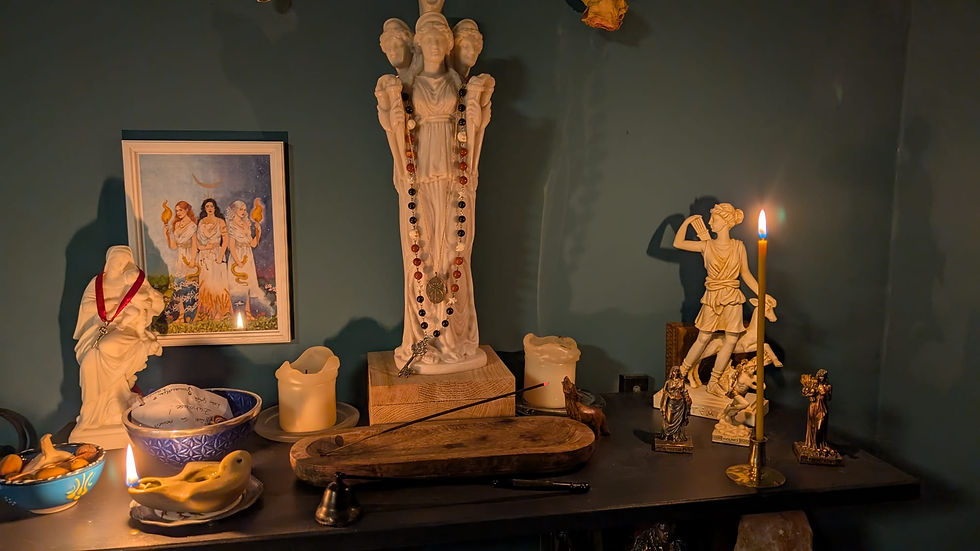
With torch in hand and roots deep, Blessed be. Sandra Maria Torchbearer - Sanctuary of Hekate Kourotrophos


Totally agree with you. The energy of times in transition are so strong and powerfull, I can feel it in the air. And yes, Hecate is there, to lead and guide the process of change.
Beautifully written. I don't feel Yule, christmas ot whatever this year, but I do feel enormous and many tresholds. Old ones, new ones. When all the people on the earth step through the threshold of 2026, every hour again a new part of the world, whether we want it or not we celebrate indeed a giant treshold that is open for as long as 24 hours. If that doens't scream Hekate, I don't know what is.
Love you for this blog.
Thanks for the excellent and inspirational post on Hekate in the liminal times and not just places. Our wonderful and gracious Hekate has been such a comfort and encouragement through these liminal times to me on a personal level. So the post really resonated with me. Thank you.