Book Review: The Temple of Hekate by Tara Sanchez
Review: The Temple of Hekate by Tara Sanchez
By Lisa May Enodia
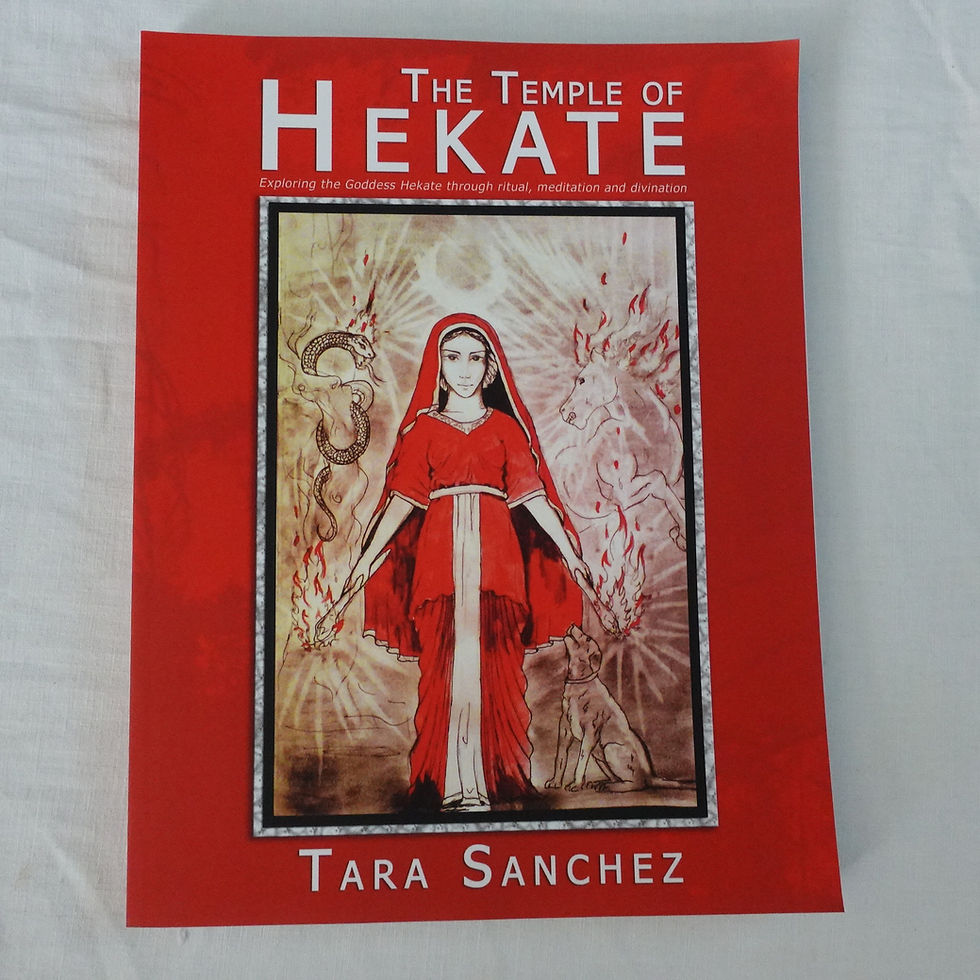
Books on Hekate often focus on history, devotion or practical magic. Tara Sanchez’s The Temple of Hekate: Exploring the Goddess Hekate through Ritual, Meditation and Divination brings these strands together within a structured system of modern practice. It considers not only what Hekate has meant historically, but how practitioners might approach her through ritual, divination and disciplined magical work. First published in 2011, the book appeared when interest in Hekate was growing rapidly but substantial practical guides remained relatively scarce. Sanchez, who was one of the early Torchbearers of the Covenant of Hekate (though no longer involved) helped to fill that space by combining historical material with witchcraft, ceremonial techniques and personal experience.
The “Temple” of the title is not an attempted reconstruction of an ancient sanctuary. It is created through practice: externally through altars, tools and ritual space, and internally through visualisation, dreams, psychic development and sustained attention.
The opening chapters establish foundations including journalling, purification, altar preparation and the creation of sacred space. These are presented not as decoration, but as the discipline upon which meaningful practice depends.
One of the book’s principal strengths is its breadth. Sanchez explores ritual gesture, sacred vowels, incense, banishing, knot magic, phylacteries, wand work, elemental practice, dream incubation and psychic development. The result is more than a devotional handbook - it is a substantial course in modern magical practice centred upon Hekate.
The sections on visualisation and psychic development are particularly useful. Rather than treating such abilities as mysterious gifts, Sanchez presents them as skills developed through patience and repetition. Her discussion of ritual gesture likewise emphasises magic as an embodied practice expressed through movement, breath, posture and presence. Divination also occupies an important place.
This illustrates one of the book’s central virtues: it respects historical material without insisting that every meaningful practice must be ancient. Contemporary creativity is welcomed, provided it is presented honestly rather than disguised as inherited tradition.
The appendices gather useful material on Hekate’s relationships with deities, animals, plants, daemons, elements, winds, planetary hours and magical correspondences.
This is not primarily an academic history or a purely devotional manual. Its centre of gravity is ritual witchcraft and ceremonial magic practised in relationship with Hekate. Readers seeking detailed archaeological or historical study will therefore need other sources alongside it.
Its enduring value lies in presenting Hekate not as an aesthetic or collection of symbols, but as the focus of sustained ritual work, discipline and sacred relationship.
Recommended for witches, occultists and Hekatean practitioners seeking a practical and historically aware approach to ritual, meditation and divination.
Published by Avalonia, The Temple of Hekate is available in paperback, ebook and audiobook editions.


Comments