Book Review: Circle for Hekate - Volume I: History & Mythology by Sorita d’Este
Book Review: Circle for Hekate - Volume I: History & Mythology by Sorita d’Este
By Lisa May Enodia
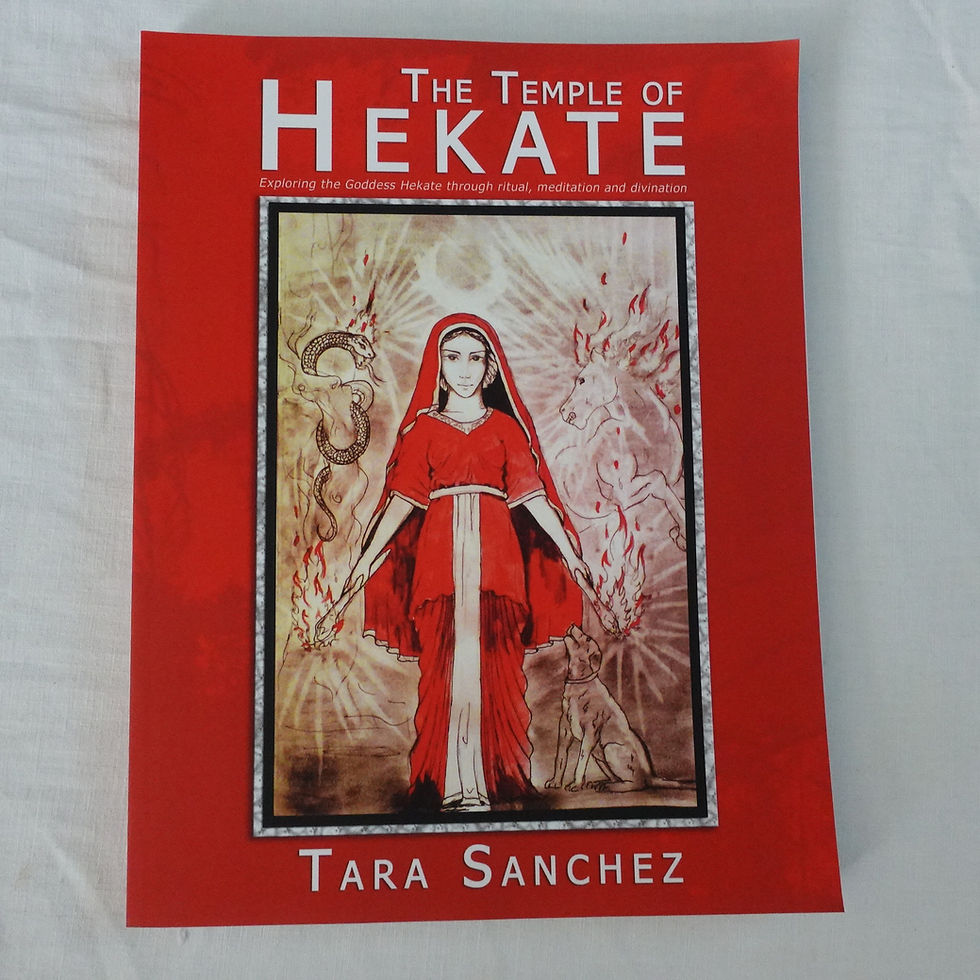
There are a lot of books about Hekate now, but Circle for Hekate - Volume I: History & Mythology by Sorita d’Este is one of the ones I keep coming back to when people ask where to begin. It is not a book of quick spells or fashionable claims. It is a source-rich, accessible and deeply considered introduction to Hekate’s history, mythology, symbols and many faces. I recommend it alongside Hekate: Liminal Rites as first books to read before continuing on to others on the Goddess.
What makes this book stand out is that it takes Hekate seriously as an ancient goddess with a long, complex and changing history. Rather than beginning with modern assumptions and working backwards, d’Este starts with the evidence - myth, literature, archaeology, cult, iconography and religious context - and uses that evidence to build a fuller picture of who Hekate has been across time.
For me, the great strength of the book is its breadth. Hekate is followed from her early appearances in Hesiod’s Theogony through her connections with mystery traditions, magic, crossroads, liminality, prophecy, initiation, household protection and the wider religious world of the ancient Mediterranean. The book also explores her relationships and overlaps with other deities, including Artemis, Demeter, Persephone, Isis, Diana and Kybele. That range matters, because Hekate was never only one thing.
This is especially important because modern writing about Hekate can often become very narrow. She is frequently reduced to the witch goddess, the dark goddess, the crone, the underworld queen, or the goddess of the crossroads. Those images are not useless, but they are partial. Circle for Hekate gives the reader a much broader view. Here Hekate appears as a goddess of divine ancestry, liminal power, protection, magic, mystery, transition and sacred presence. She is connected with the household and the road, with gods and mortals, with the dead and the living, with the visible world and the unseen.
One of the most valuable parts of the book is the way it handles Hekate’s divine ancestry. The discussion of Hesiod’s Theogony is especially useful because it brings readers back to one of the earliest literary sources in which Hekate appears. In Hesiod, she is not a marginal or sinister figure. She is honoured by Zeus, given a share in earth, sea and sky, and presented as a goddess of wide-ranging power and favour. That alone challenges a great deal of modern simplification.

Readers often find this part of the book eye-opening, because it restores a larger Hekate. She is not introduced as a minor goddess lurking at the edge of Greek religion, but as a deity with ancient dignity and extensive powers. This is one of the places where the book really earns its value: it reminds us that Hekate’s later associations with witchcraft, ghosts and the crossroads sit on top of something older, broader and more luminous.
The material on Hekate’s links with other goddesses is another highlight. D’Este explores the ways Hekate intersects with figures such as Artemis, Demeter, Persephone, Isis, Diana and Kybele, showing how her identity moves across different religious landscapes. This does not make Hekate vague or interchangeable. Instead, it shows how flexible and powerful her image became. She could be understood in relation to the maiden of the wild, the mother of the mysteries, the daughter of the underworld, the universal goddess, and the protective power at the threshold.
That is one of the most fascinating things about Hekate: she does not stay neatly inside one category. Circle for Hekate allows the reader to see that without forcing the evidence into a single modern system. Hekate is presented as many-faced because the sources themselves are many-layered. Her story stretches through myth, cult, magic, household religion, mystery traditions and later interpretation, and the book gives space to that complexity.
The discussion of symbols is also very strong. Torches, keys, dogs, serpents, crossroads, triple forms, liminal places and sacred animals are not treated as decorative occult accessories. They are explored as meaningful parts of Hekate’s history and religious identity. This is important because so many of these symbols have become popular in modern witchcraft, often detached from their older contexts. D’Este helps reconnect them to the ancient material.
I also appreciate the way the book balances scholarship and readability. It is clearly built on a wide range of sources, but it does not feel locked behind academic language. You do not need to be a classicist to follow it, but you are also not being given a watered-down version of the subject. The reader is trusted to engage with ancient sources, uncertainty and complexity.
That balance is one of the reasons I think this book works so well as an introduction. It is accessible without being shallow. It gives newcomers a strong foundation, but it also gives more experienced readers plenty to think about. If you already know Hekate Liminal Rites, this volume expands the field further, especially in relation to mythology, divine ancestry, iconography and the broader historical development of Hekate’s image.
Some readers may find the book information-rich. It is not a light, fluffy read. There are names, sources, associations and historical layers to take in. But that is part of its value. Hekate is not a simple goddess, and a useful book about her should not pretend that she is. The reward is that you come away with a much more substantial understanding of her.
What I particularly like is that the book does not strip Hekate of mystery by explaining her. It does the opposite. By returning to the sources, it shows that the mystery is deeper than the modern clichés. Hekate becomes not less magical, but more interesting. Not less powerful, but more historically grounded. Not less relevant, but more enduring.
A practical point is also worth mentioning: compared with many books on Hekate, witchcraft and ancient magic, Circle for Hekate - Volume I is a substantial and worthwhile book for the price. It offers 268 pages of focused material, careful research and useful discussion, making it a strong addition to a Hekate library without feeling like an inaccessible specialist volume. For readers building a serious collection, that matters.
In the end, Circle for Hekate - Volume I is important because it gives readers a historically grounded way into Hekate’s many faces. It is a book about history and mythology, but it is also a book about seeing more clearly. It helps clear away the flattened modern image and replaces it with something richer, older and far more compelling.
For anyone seriously interested in Hekate - whether as a devotee, witch, researcher, polytheist, occultist or student of ancient religion - this is a book that deserves space on the shelf. It does not claim to be the final word, and that is part of its strength. It is a foundation, a guide through sources, and an invitation to meet Hekate in her complexity.
Highly recommended if you want Hekate with history, mythology, depth and real substance.
Available from Avalonia directly, from the usual online bookstores, your local Pagan store, and also as a Kindle eBook for convenience.


Comments